Wednesday, June 3, 2015

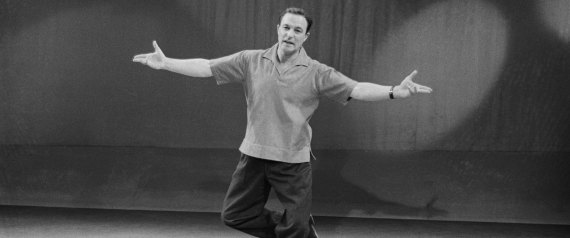
Gene Kelly at His Best

Summer Classic: Gene Kelly's favorite film,

An American in Paris


What decade in film the 1950s was.
The era's movies exhibited America's newfound post-war affluence and the rise of the middle-class. Crowds reacted positively to Hollywood's introduction of the anti-hero as actors such as James Dean, Paul Newman and Marlon Brando stepped into the spotlight.
But one of the classic film genres, the movie musical, was still thriving and evolving under the care of artists such as Gene Kelly, who led two of his defining films in the early '50s:Singin' in the Rain (1952) and An American in Paris (1951), which is the feature Wednesday in the Kentucky Theatre's Summer Classics Series.
Kelly's brand of zany, eccentric dancing made him the face of movie musicals until the form dissipated in the late '50s.
He starred in, choreographed and produced American in Paris, which he said was his favorite musical of his career.
The plot centers on a trio of American artists living in post-World War II France and the romantic entanglements of Kelly's character, Jerry, who is the object of one woman's affection, though he has fallen for a French woman, unaware she is in a long-term relationship with one of his friends.
When your heart is broken, gotta dance.
The movie is most famous for its 17-minute dance sequence toward the end. In fact, there is no dialogue for the final 20 minutes and 25 seconds of the film. This major achievement in choreography took more than a month to film and allegedly cost about $500,000 to pull off.
Kelly's co-star Leslie Caron made her cinematic debut in the film and Oscar Levant, Nina Foch and Georges Guétary round out the small cast.
In addition to Kelly's work, a major calling card for An American in Paris was the music of George Gershwin including his 1928 orchestral composition of the same name. The film also includes classic Gershwin tunes such as, Embraceable You, S Wonderful and I Got Rhythm.
For theater fans, Wednesday's screenings can be a prelude to Sunday night's Tony Awards, where the stage adaptation of An American in Paris is up for 12 trophies, including best musical.
Kyle Arensdorf: (859) 231-3335. Twitter: @KYleKernel.


Read more here: http://www.kentucky.com/2015/06/02/3881334/summer-classic-gene-kellys-favorite.html#storylink=cpy

Thursday, May 28, 2015

Claire Bloom of Limelight, On Chaplin

Clair Bloom on Chaplin

The Criterion Collection has released a clip from an exclusive new interview with actress Claire Bloom, which appears on the recent Blu-ray release of Charlie Chaplin's final American film, Limelight

Limelight

Charlie Chaplin's masterful drama about the twilight of a former vaudeville star is among the writer-director's most touching films. Chaplin plays Calvero, a once beloved musical-comedy performer, now a washed-up alcoholic who lives in a small London flat. A glimmer of hope arrives when he meets a beautiful but melancholy ballerina (Claire Bloom) who lives downstairs. An elegant mix of the comic and the tragic, this poignant film also features Buster Keaton in an extended cameo, marking the only time the two silent comedy icons appeared together on-screen. Made at a time when Chaplin was under attack by the American press and far right, Limelight was barely distributed in the United States upon its initial release, but it is now considered one of his essential and most personal works.

Monday, May 18, 2015

Tim Cook on Steve Jobs


Tim Cook on Steve Jobs

In a powerful commencement address to George Washington University graduates, Apple CEO Tim Cook implored the class of 2015 to follow in the footsteps of Steve Jobs.

Many view work as boring, hopeless drudgery -- a view Cook said he shared in 1997 before he came to Apple (AAPLTech30).
But Cook said Steve Jobs made him question everything he thought was true. Jobs persuaded him that "doing good and doing well" were not mutually exclusive.
"I always figured that work was work," Cook said. "There were things I wanted to change about the world, but I figured that was what I had to do on my own time. Steve didn't see it that way. He convinced me that if we made great products, we too could change the world."
As an example, Cook pointed to features on iPads, Macs and iPhones that allow blind people to communicate with their friends and family.
On how to change the world: Cook also referred to citizen journalists who use their smartphones to capture and report police brutality. He got loud applause when he said that Apple products can empower people who witness injustice, because people now have a camera in their pocket all the time.
"At Apple, we believe the work should be more than about improving your own self; it's about improving others' lives as well," Cook said. "We believe that a company with values and acts on them really can change the world."
On meeting George Wallace and Jimmy Carter: Cook said his moral compass was tuned when he met both Alabama governor George Wallace and President Jimmy Carter as a high school student in the summer of 1977.
Apple's CEO was born into a poor family in Alabama, and by the time he was in high school, he still hadn't left the south. But he said meeting the segregationist Wallace "was not an honor for me."
"Shaking his hand felt like a betrayal of my own beliefs, like I was selling a piece of my soul," Cook said of his introduction to the notoriously racist governor.
Instead, meeting Carter was more of a highlight for Cook. Though Carter had been the governor of another, bordering southern state (Georgia), and like Wallace was a Democrat, Cook said Carter approached life differently. He was "kind and compassionate," Cook said.
"One was right, and one was wrong," Cook said of Carter and Wallace.
Tim Cook in 90 seconds
On Steve Jobs and the 'North Star': Cook's advice to the graduates of the class of 2015 was to use their own morality as their guides. He encouraged them to have Jobs' optimism that work could better the world, and he urged them to embody Carter's humanity -- something Cook said the president "had not sacrificed" despite holding the highest job in the world.
"Your values matter. They are your North Star," Cook said. "Otherwise it's just a job, and life is too short for that. The sidelines are not where you want to live your life. There are problems that need to be solved and injustices that need to be ended."
Cook ended his address by taking a photo of the graduating class with his iPhone.
Sunday's speech was the first commencement address delivered by an Apple CEO since Steve Jobs spoke at Stanford University's graduation in 2005. Cook also delivered a commencement address at Auburn University, his alma mater, in 2010, when he was Apple's chief operating officer.

Gene Kelly Exhibit


Gene Kelly Exhibit


_DSC0131.jpg

Sheepish Chaplin

Sheepish secret that shaped Charlie Chaplin


Fiona O’Connell

PUBLISHED10/05/2015 | 02:30

Charlie Chaplin in City LightsOPEN GALLERY 1
Charlie Chaplin in City Lights
I'm with George Bernard Shaw, who said "animals are my friends...and I don't eat my friends." But neither do I eat the head off carnivores - or those who supply their demands. Especially as one of the most decent landlords I ever had was a butcher.
Ireland is not a renter's paradise, and many of the property owners I leased from over the years were fairly horrible. But he was both a butcher and a gentleman. He'd always greet me, when I came downstairs from the flat above his premises, with a "Morning, Fiona!" and a big, friendly smile - standing there all rosy-cheeked and cheerful, cleaver in hand and his apron splattered with blood.
I lived there for ages, despite the smell of raw meat that came up through the floorboards in summer. He is still carving up carcasses on Dublin's Wexford Street, and I still pop in for a chat if I'm in the city and passing.
The butchers in this country town seem likewise a lovely lot - unless you've got 'prime cut' printed across your person.
I often see a traffic cone set outside the adjoining abattoir when I'm on my way to pick up the Sunday Independent, the space occupied by a vehicle with a livestock trailer attached by the time I'm walking back.
Sometimes I watch as the animals are unloaded and corralled down the side entrance. It reminds me of the part in Charlie Chaplin's autobiography, where he pinpoints the defining moment of his life.
Chaplin often stayed with his aunt in the east end of London during his childhood, where there was an abattoir at the end of the road. One day, one of the sheep being herded to its death managed to escape.
It made a frantic bid for freedom down the crowded row of shops and houses, knocking over important-looking individuals. Grand-hatted dames collided bum-over-heel with pot-bellied businessmen in bowler hats. Fruit rolled everywhere, making people unwilling participants in the unfolding slapstick.
A delighted four-year-old Chaplin stood watching it all, laughing at the failed attempts of red-cheeked workers to catch the sheep, who kicked up its black hooves and valiantly resisted.
Until the inevitable happened, and the sheep was captured. It was held in a wrestler's grip until butchers in bloodied aprons came to claim it. Only then did Chaplin realise the fate that awaited the fleecy fugitive who had caused so much fun.
Chaplin said that event crystallised the humour that he would go on to master.
Sometimes I remember him when I glimpse sheep between the trailer slats outside the abattoir. Life continues around them, as if everything is normal. But a curtain is about to fall on those cowering creatures - like the one that signalled 'the end' in a silent movie.
Because rent is owing on use of their landlord's fields.

Chaplin for the Ages

Top Actors of All Time

Sunday, February 22, 2015

A Rare Relaxed View of Chaplin

Click

The link above shows a 74-year-old clip of the comedy actor, never before seen,
relaxed and doing mocking imitations of his contemporary Hollywood stars

Thursday, December 18, 2014

Chapin, Sony, Hitler & Kim Jong Un


I find it amazing that in this day and age anyone really cares about the content of the movie, "The Interview", by Sony Pictures.  The issue isn't the movie, but more about a failed state, North Korea, with a caricature of a dictator, Kim Jung Un, being able to dictate to one of our movie studios what movie to make.  Hollywood can and should make movies about any subject they want without fear of reprisals, threats or blackmail from some joke of a country with some decent hacking skills.

I'm embarrassed for Sony in kowtowing to these vague threats and pulling the picture. I think it was more the theater owner's fear of lost business on other movies rather than any real threat to anyone. Sony would not have made much money on the movie anyway so it is no real loss to them, but it is a loss of spine and the first step in our studios being bullied by foreign governments.

We only need to look back to 1940 for a similar episode to this one.  One of the greatest film makers of all time and one of the most famous men in the history of movies, Charlie Chaplin, had a similar experience with a far different outcome.  Chaplin was fascinated by Hitler in the late 1930s and admired his acting skills and oratory.  He hated Hitler, however, for what was going on in Germany and Europe.  Against the advice of all of the major studios, some powerful politicians and even his own brother, Chaplin went on to write, star, direct and produce his brilliant mockery of Adolf Hitler with his movie, The Great Dictator.

See Trailer Here: Trailer

At the time Chaplin started the project, 1937-38, Hitler was actually still admired by many people in the US who hid their heads in the sand.  By the time the movie came out in 1940, the full extent of Hitlers crimes against humanity were coming to light.  Chaplin was the only one in Hollywood to come out publicly against him. As Chaplin ran an independent studio and used his own money to make pictures, he was not subject to corporate pressures.  The other studios, all run by Eastern European members of the Jewish faith, had already acquiesced to Hitlers demands and removed their Jewish management from their German based affiliates and replaced them all with gentiles.

The movie Chaplin made was a masterpiece of mockery based on Hitler using the name Henkel as the head of the repressive state of Tomania.  The movie made a ton of money and was hailed as a masterpiece, even today holding an 8.5 rating in the top 100 at IMDB.

Chaplin was unafraid and used his comical genius to make a fool of Hitler when no one else would.

Sony, you need to look to the past and to the truly great pioneers of the film industry.  Have some guts.


Wednesday, December 17, 2014

Chaplin & Bob Hope

The funny similarities between Charlie Chaplin and Bob Hope 

A pair of new biographies show that the legendary comedians weren't so unalike after all.

A hundred years ago, Charlie Chaplin was the biggest film comedian in the United States. Drawing on the pantomime he'd mastered in the British music halls, the 25-year-old expatriate had pioneered a new style of slapstick comedy in American silent films, more leisurely and character based than the frantic action of the Keystone Cops, and moviegoers were enthralled. As Peter Ackroyd recounts in his new biographyChaplin: A Brief Life, Chaplin's fame spread around the world in 1915, his character the Tramp becoming a beloved figure to some 300 million people. He was celebrated in books, songs, comic strips, and nursery rhymes; the Tramp was merchandised with dolls, toys, clothing, charms, and plaster statuettes. Chaplin imitators adopted his signature costume of bowler hat, square mustache, too-small coat, bamboo cane, baggy pants, and oversize shoes; that summer at Luna Park, an amusement park in Cleveland, a crowd turned out for a Chaplin impersonation contest. The winner was a local 12-year-old who, 30 years later, would himself become the biggest film comedian in the U.S., performing as Bob Hope.
The two men are seldom mentioned in the same breath: Chaplin is revered not only as a performer but as one of the greatest Hollywood filmmakers, whereas Hope spent the last 40 years of his life tarnishing his great screen legacy with lazy, complacent NBC specials (he died in 2003 at the age of 100). Chaplin's life and work have been documented so exhaustively that Ackroyd's book, in keeping with the title, succeeds by virtue of its brevity; beautifully written, emotionally incisive, and critically astute, it provides the ideal entree for someone unfamiliar with Chaplin's life. Richard Zoglin takes on quite a different agenda with his massive Hope: Entertainer of the Century; definitive and exhaustively researched, this new biography sets out to rescue Hope's reputation, making a case for him not only as a groundbreaking comedian who conquered movies, TV, radio, and the Broadway stage but as a businessman and public servant whose accomplishments in the 1940s, '50s, and '60s have been emulated by Hollywood stars ever since.
Considered side by side, the books also reveal men who were strikingly similar despite the obvious polarities in their art (Chaplin's comedy was physical, Hope's primarily verbal) and their politics (Chaplin was a socialist, Hope a staunch conservative). Both were born in Britain and grew up in dire poverty, Chaplin emigrating to the U.S. as a young man and Hope coming to Cleveland with his family at age five. Both were ill educated and took up show business as a means of survival, growing addicted to the spotlight and obsessed with themselves. Both were compulsive workaholics of unchecked ambition who neglected their wives and children, public men who were perceived by their intimates as being empty inside. And each man traveled the same career arc, enjoying a period of synchronicity with the American mood but, in his old age, falling badly out of step, Chaplin with his pro-Soviet sentiments during the red scare of the late 1940s and Hope with his knee-jerk support of the Vietnam war and the Nixon White House in the early 1970s.
Chaplin's traumatic upbringing in South London was etched into his art and his personal character. His mother, Hannah Hill, married Charles Chaplin Sr., an alcoholic music-hall singer, when she was already pregnant with another man's child; he adopted the boy, Sydney, and in 1889, Hannah gave birth to Charles Jr., though she was so promiscuous that Charlie would always wonder who his true father was. After the couple split up, Hannah remarried, but that marriage collapsed too; from 1896 onward the two boys bounced around from their respective parents' custody to the workhouse to a school for orphans, and by 1898 their mother had been consigned to an insane asylum. From a tender age Chaplin learned to swipe food from street stalls and dance for pennies outside the local public houses. The year his mother was institutionalized, he embarked on a music-hall career of his own, performing with a group of clog dancers called the Eight Lancashire Lads.
The music halls were the British equivalent of vaudeville—cheap, crowd-pleasing, lower-class entertainment—and from them Chaplin learned the traditional pantomime that would stand him in such good stead on the screen. "Movement is liberated thought," he told an interviewer in 1942; when shooting a movie, he always made sure his feet were in the frame so people could see his whole body. He made a name for himself in England with the Fred Karno comedy troupe and in 1910 accompanied Karno to the U.S. for a vaudeville tour. When Chaplin was hired by the Keystone Studios in late 1913, he immediately distinguished himself with his elegant body language, and after a few appearances he came up with the Tramp character, an immediate hit. Comparing Chaplin with Ford Sterling, chief of the Keystone Cops, Ackroyd pinpoints the innovation that made the young Brit a star overnight: Sterling specialized in "florid gestures, exaggerated expressions and a general tendency to be over-theatrical. . . . Chaplin was in contrast more contained and much stiller . . . Sterling had only an outer, while Chaplin possessed an inner, life."
Hope's childhood wasn't as horrible as Chaplin's, but he grew up plenty hungry. His father, Harry Hope, was an underemployed stonemason who took to drink out of frustration, moving his family from London to Lewisham to Eltham (where the comedian was born Leslie Townes Hope in 1903) to Weston-super-Mare and, finally, to Cleveland, where two of Harry's brothers had already emigrated. Hope's mother, a much stronger woman than Hannah Chaplin, held the family together, but Leslie and his five brothers all went to work as soon as they were able, contributing their earnings to the family budget. Leslie was shaping up as a pool hustler and petty thief, and between 1918 and 1921 he spent at least a year and a half in reform school before his talents as a singer (like Chaplin, he performed on the street for pennies) and a dancer led him into show business. By age 21, he was touring vaudeville theaters as part of a comedy-dance duo, and in 1927 he made his premiere on Broadway in the revue Sidewalks of New York.
As a physical comedian, Hope had his moments—check out his rubber-legged walk after he's released from a steamer trunk in The Ghost Breakers (1940)—but the key to his success was his verbal wit. He came of age in vaudeville when the old tradition of performers being heralded onstage with cards on an easel had been superseded by the emcee, who would tell jokes, ad-lib with the audience, and announce each act. Hope learned his craft from Frank Fay, a popular comedian of the era, and soon became a master, quick on his feet and skilled in handling any sort of audience. He began building an encyclopedic joke file and hired a giant staff of writers. When he got into radio in 1935, he developed a lightning-quick pace, and within a few years, elaborating on the political satire of his idol Will Rogers, he'd more or less invented the topical monologue that would become the template for Johnny Carson, David Letterman, and every late-night broadcaster after them.
Hope may have had the gift of gab and Chaplin the gift of mime, but as portrayed by their biographers, they were both meticulous in the art of getting laughs. As a director, Chaplin tended to begin with a premise and improvise on the set, burning through miles of film stock as he worked out his ideas; he would coach his players in the minutest aspects of movement and expression, putting them through dozens upon dozens of takes until he got exactly what he wanted. Hope was similarly precise in creating his material; his overworked writers would deliver dozens of jokes on a single subject and Hope would sift through them to assemble his monologues. "When you wrote for Hope, you learned not to put one word extra in," recalled Sherwood Schwartz. "He knew how to pack it in, pace it, and fill it. You had to write all bone and make a great joke in twenty-four words or less." In addition to his skill as an editor, Hope could come up with killer lines all his own, and his ad-libs often got bigger laughs than the prepared material.
"I want you to know that you are one of the best timers of comedy I've ever seen," Chaplin told Hope when the two men met in April 1939. Hope was shooting The Cat and the Canary, a haunted-house comedy that would cement his movie persona as a wisecracking coward, and his costar was Paulette Goddard, Chaplin's third wife. The younger man was elated to hear such high praise from an artist he'd always worshipped, yet their meeting came at radically different points in their movie careers. Hope's was about to explode: after The Cat and the Canary he would costar with Bing Crosby in Road to Singapore (1940), inaugurating a series of wildly anarchic buddy comedies, and on his own he would rack up such gems as Caught in the Draft (1941), My Favorite Blonde (1942), Monsieur Beaucaire (1946), The Paleface (1948), and Son of Paleface(1952). By contrast, Chaplin was preparing his antifascist satire The Great Dictator (1940), in which he would play the Tramp for the very last time; his Hollywood career would never recover.
Twenty years earlier, Americans had looked at the Tramp and seen themselves. The essence of the character, Ackroyd notes, can be seen in the famous final shot of The Tramp (1915), when Chaplin trudges sadly down a country lane, his back to the audience, but then rouses himself: "His little dance upon the road is a form of self-definition. He is free. He is essentially alone but he will never truly be lonely because he is infinitely resourceful. . . . He has the will to live in a world that may not be worth living in. The open road is an important conclusion to him; it implies an endless journey, with the Tramp implicitly in the role of Everyman." But that was a different America, and silent movies a different medium. By the time Hope and Chaplin met, the older man had spent more than a decade trying to ignore the advent of sound: his only two movies since then, City Lights (1931) and Modern Times (1935), were both silent, as anachronistic as they were brilliant.
By the war years, Americans were more likely to see themselves in Bob Hope. "He was brash, sophisticated, modern," writes Zoglin. "He was an all-American wise guy, accessible to everyone." Woody Allen, who adored Hope and based his own comic persona on Hope's quivering quipster, appreciated his average-guy appeal: "He was not a sufferer, like Chaplin, or even as dimensional as someone like Groucho Marx, who suggested a kind of intellect," Allen says. "Hope was just a superficial, smiling guy tossing off one-liners. But he was amazingly good at it." What really endeared Hope to Americans, however, was his tireless career as a public servant, raising money for humanitarian causes and criss-crossing the globe to perform for servicemen in international hot spots. As a USO volunteer in World War II, he made extended (and sometimes genuinely dangerous) tours of Britain, North Africa, and the Pacific, showing up in the remotest outposts with his little entourage of singers and comedians. Soldiers far from home sent him thousands of letters, and he answered nearly all of them.
That was in public; in private Chaplin and Hope were both difficult personalities. Chaplin went through a string of wives and treated most of them abominably. He liked them young—his first and second wives, Mildred Harris and Lita Grey, were each 16 when he married them—and he always maintained the upper hand. His last marriage, to Oona O'Neill (daughter of the playwright Eugene O'Neill) lasted 34 years, but only because she catered to his every whim. Hope stuck with his second wife, Dolores Reade, for nearly 60 years, but he was notorious for his serial affairs, which were studiously ignored by Reade, a devout Catholic. (Among Hope's conquests, Zoglin reveals, was none other than America's sweetheart, Doris Day.) Both men neglected their children, breezing in and out of their lives, and bullied their colleagues. Marlon Brando, who starred in Chaplin's A Countess From Hong Kong (1967), called him "an egotistical tyrant," and Katharine Hepburn, who costarred with Hope in The Iron Petticoat (1956), thought him "the biggest egomaniac with whom I have worked in my entire life."
Poverty left its mark on both men. When they became successful, they instinctually turned to their siblings for protection; Sydney Chaplin cut short his own career as a performer to become his brother's manager, and Hope pulled his brothers Jack and George into his organization. Chaplin was haunted by the fear of winding up on the street again and, contrary to his socialist tendencies, invested heavily in the stock market; Hope sank most of his money into real estate, and at one point Forbes magazine estimated his net worth at $280 million (after he protested, the magazine revised the figure down to $115 milllion). Despite their philanthropic endeavors, both men were known as terrible cheapskates. "On payday," writes Zoglin, "Hope used to stand at the top of the circular staircase in his house, make paper airplanes out of the writers' paychecks, and float them downstairs, forcing the writers to grovel on the floor for their wages." He gave millions to charity but would complain when the video editors working late on his TV shows ordered pizza on his dime.
Chaplin and Hope may have been most alike in their sheer impenetrability; both men lived for the spotlight but seemed to have no inner life, shying away from any sort of emotion. As Ackroyd writes, Chaplin became more remote as his fame increased: "The popularity drove him further into himself; he became more aware of his fundamental isolation." Thomas Burke, a British writer who squired Chaplin around East London when the star returned to the UK in 1921, observed that "he is first and last an actor. He lives only in a role, and without it he is lost. As he cannot find the inner Chaplin, there is nothing for him, at grievous moments, to fall into." Burke's words are eerily echoed by Martin Ragaway, one of Hope's gag writers in the early 1960s: "Deep down inside, there is no Bob Hope. . . . He's shallow in the sense that he's never taken the time to look into himself, and he won't let others do it either."
In the end both men saw their cherished relationships with the public turn bitter. World War II may have made Hope, but it unmade Chaplin. "Patriotism is the greatest insanity the world has ever suffered," he had declared during another trip to London in 1931, and American critics were incensed by the Tramp's speech at the end of The Great Dictator: "Soldiers! Don't give yourselves to these brutes . . . who will drill you, diet you, treat you like cattle, and use you as cannon fodder." His absence from the USO circuit was noted, and after the war his pro-Soviet sympathies landed him in the crosshairs of the House Un-American Activities Committee. His black comedy Monsieur Verdoux (1947), in which he plays a wealthy serial killer, was vilified as an attack on American mores, and in 1952, while he was overseas promoting his nostalgic dramaLimelight, he was denied reentry into the U.S. unless he would submit to an FBI investigation of his political affiliations. For the rest of his life, he made his home in Switzerland.
Chaplin returned to the U.S. only once, to accept a lifetime-achievement Oscar at the 1972 Academy Awards. (Driven around Los Angeles, which he hadn't seen in 20 years, he marveled, "It's all banks, banks, banks!") By that time Hope too had lost the pulse of America, defending the Vietnam war with condescending jokes about antiwar hippies and serving as a mouthpiece for President Nixon. His Christmas shows for American troops had become a TV perennial, but in 1969 he was roundly booed during a stop in Lai Khe when he mentioned Nixon's plan to end the war. "When the TV cameras panned the crowd, the GIs were standing up and giving the finger and making power salutes," one observer told Rolling Stone. "Then the troops started throwing things and tried to rush the stage. . . . Hope, who was visibly shaken, had to stop the show and leave." Hope's stock plummeted even further during the Watergate scandal, when he came to Nixon's defense and stuck by the president even after he'd resigned in disgrace.
"He seemed in the end to be at peace," Ackroyd writes of Chaplin, "but in effect he had withdrawn into a vast and silent sphere of self-regard." By the time Chaplin died in 1979, at age 88, his reputation had been restored, and new generations of moviegoers have embraced him even as the silent cinema continues to slip away. Hope outlived Chaplin by more than 20 years, refusing to go away and wearing out his welcome as an elder statesman of comedy; young people today, if they remember Hope at all, remember a smug octogenarian carrying a golf club and reading from cue cards. Whether Zoglin's book will prompt people to rediscover the edgy young movie comedian of the 1940s remains to be seen, but both Chaplin and Hope understood only too well that the selves they created for the public would be the only thing they left behind.

Saturday, November 29, 2014

The Joy of Research

Sometimes the joy of research for my book has overtaken the writing process.  I can't stop reading about Chaplin, Kelly and Jobs.  There are over 600 book on Chaplin with most being regurgitations of previous works.  I'd estimate that there are only two dozen really good works.  There are 85 movies to watch also and each must be watched two or three times to really see the many nuances in his work.

Gene Kelly has far fewer books about his life and there are only 6 or so that are noteworthy.  He has 45 movies and, again, each must be watched numerous times.  I say, must be watched, but for Kelly and Chaplin, it's a joy and I'm amazed with each viewing as I see different aspects of their genius.

Steve Jobs is almost the outlier in this group, because he was not an entertainer, but with the premise of the book being perfectionism, he fits.  All three men were brutal to work for, demanding, mean in some cases and egotistical, but all were only interested in providing the best product and getting the best from their people.

Chaplin and Kelly forced actors to work through dozens of takes on a single scene until it was right. Chaplin often went into hundreds of takes for one scene.  Steve Jobs would force workers to go back to the drawing board over and over again to got to the perfection he envisioned for a product of feature.  He would study hundreds of prototypes until he was satisfied.

Two or three books come out each year on Chaplin.  Only a book every two or three year or so on Kelly is published.  Steve Jobs is the subject of many books from basic biographical accounts to studies of his management and presentations styles.

I could be totally happy just doing research, but the book calls and I need to finish.

Monday, November 17, 2014

Review of Peter Ackroyd's "Charlie Chaplin: A Brief Life"

Over 600 books have been written about Charlie Chaplin.  Most are simple regurgitations of other books.  As one author put it, "People will read five books and publish a sixth".  Peter Ackroyd's book is pretty much a compilation of many other books.  I have read over 30 books on Chaplin so far, picking and choosing from the the best out there, as well as hundreds of journal articles on him and seeing every movie at least twice.  Ackroyd's book has a few small details I had not seen before and a few minor mistakes of fact.

It is so hard to separate fact from fiction on Chaplin due to the quantity of books published, but when only one book states something, it is immediately suspect.  When I see something in book after book, I begin to take it as fact.  Ackroyd's book does offer some juicy tidbits on Chaplin's personal life when it comes to his female conquests as well as the controversies therin, but not much new about his work life or movies.  This is not meant as a criticism as there is little out there new to find unless one of his children decides to write a book or one of the few people left alive who worked with him. Sophia Loren or Claire Bloom might decide to talk on the record about their time with Chaplin, but there are a precious few others, and those would be distant spectators rather than principal players.

The book is pleasant reading overall and well written.  Ackroyd's style of writing makes it comfortable to just sit and read.  Many other books on Chaplin are not.  His son Sydney wrote a book that was hard to read and Georgia Hale's book was a pain due to her lack of time references.  I could not always tell from the context when things were happening even though I consider myself well read on the subject.

Details like Chaplin painting his private parts with Iodine are not relevant to the genius that he was. Bedroom details never make for a good book unless an author is writing a book about what goes on in the bedroom.  These details don't help us to understand his genius or his talent, but are meant to be salacious tidbits for shock value.

That being said, I enjoyed the book.

Thursday, November 13, 2014

Remake An American in Paris? Are they nuts?

An American in Paris Without Gene Kelly? by Patricia Ward Kelly

GENE KELLY
When I learned recently that so many of my good friends were cast in the upcoming "reimagining" of An American in Paris, I eagerly went to the website to read about the new production scheduled to premiere at the Théâtre du Châtelet in Paris on December 10, 2014, and to open in New York City next spring. Because the movie was such an important part of Gene's career -- and meant so much to him personally -- I was surprised not to see him even mentioned on the page.
When Gene first brought me to California to write his memoir back in 1986, he was, for me, essentially a blank slate. I had to get up to speed on everything. Because I would eventually wear the dual hat of wife and biographer, I felt it incumbent upon me to double- and triple-check my primary source -- my husband. As a result, I spent hours at the University of Southern California library exploring the expansive Arthur Freed collection. Most of Hollywood had little or no regard for its history (film scores were tossed in a landfill, and film cans were often of more value to executives than the film in them). Fortunately, Freed donated the records and production notes of many of my husband's greatest and best-known films, including An American in Paris andSingin' in the Rain. These minute-by-minute accounts provide a remarkably detailed -- and accurate -- record of the preparation, rehearsals and shooting schedules of the movies. In the notes regarding An American in Paris, Gene is frequently listed as "Director," with Minnelli's name following in parentheses.
While Freed was producer of the MGM musical and Minnelli the credited director, Gene was the choreographer of the picture and also the director of several important segments of the film, including "Embraceable You," "I Got Rhythm," and the ground-breaking, seventeen-and-one-half-minute "An American in Paris Ballet." When I asked Gene about his involvement, he said, "I discussed the shooting with Vincente Minnelli and the cameraman. But I had final control of the camera. If it ever came to a question, I would have the last word. The director usually has final say. ... But it was my baby, mainly, even though it was a collaborative effort." As Leslie Caron confirmed when asked to comment about Minnelli's role shooting the picture, "Oh, no, it was Gene Kelly behind the camera!"
On the website for the new stage version, Arthur Freed is described as the "one who put together a set of existing songs on which he created a story." According to Gene, it was he and Minnelli who chose the songs and the writer Alan Jay Lerner who crafted the script on a typewriter as he sat in his bed at the famed Bel Air Hotel. "We had a choice of every song the Gershwins ever wrote," Gene said, explaining the selection of numbers. "You might say, 'Oh, boy, what riches.' But we didn't know what to select -- we spent more time trying to fit the songs in. ... I don't think we could have ever doneAn American in Paris if we hadn't had someone like Alan Jay Lerner, who could adapt every time Minnelli and I changed a song and put it in a different place."
Though Gene did not receive any of the film's eight Academy Award nominations, he was presented with a special honorary Oscar "in appreciation for his extreme versatility as an actor, singer, director, and dancer, and specifically for his brilliant achievements in the art of choreography on film." That the history of the film is so badly bungled in the presentation of the new production -- and that Gene is omitted entirely -- is both sad and careless.

I have been told that the new stage production diverges significantly from the original; that the story, the music and the dance are changed. If this is the case -- if everything is indeed altered so considerably -- why is it then called An American in Paris?
Gene never relished seeing his own films. He watched them with me, begrudgingly, because of our work together. But he always saw things he could have done better. One exception was An American in Paris. Though he disliked the opening number, "By Strauss," which he felt "never came off," he thought the rest held up. As we ran the film together, nearly 40 years after its inception, he said frankly, "Take those first 10 minutes out, which are embarrassing, and it's a great picture, and, in 1951, way ahead of its time." When we eventually reached the end, he turned to me and said, "I'm glad I saw it. There are some things in there that are sensational -- that nobody else could have done -- and I'm proud of them." It was an important confession for a man who found it difficult to say, "I did that."
The last project Gene was engaged to do before his massive stroke in July 1994 was a recreation of the "American in Paris Ballet" for the Three Tenors Concert at Dodger Stadium. He was excited about the work -- it would be his "swan song," he said -- and each night he sat in his chair with a yellow legal pad drafting ideas well into the wee hours of the morning. He was very proud to be joining a team of friends and esteemed professionals: Zubin Mehta, Plácido Domingo, Luciano Pavarotti, José Carerras. Determined to make the ballet something special and unique, he enlisted the award-winning production designer Rene Lagler to design the set and contacted Helgi Tómasson, the artistic director of San Francisco Ballet, about the possibility of using several dancers from the company. Instead of just one pair, as in the movie, Gene wanted multiple pairs to convey the emotion of each section of the ballet. Sadly, this beautifully-conceived project never came to pass.
Gene would be the last person to want new generations to mimic his work. He always encouraged young people to take what he did and go beyond. Similarly, he would never wish for those following in his footsteps to forget the important role he and others played in both the creation and execution of the masterpiece that begat this new production.
At the very least, the producers should rightfully acknowledge the very broad shoulders upon which they stand.

Sunday, November 9, 2014

City Light; Perhaps Chaplin's Greatest Film

Shakkyo: How Charlie Chaplin's City Lights crossed boundaries

An unlikely double bill at Tokyo International Film Festival proved one of the best ideas a film festival has ever had, says Robbie Collin

Charlie Chaplin in the 1931 classic City Lights
Charlie Chaplin in the 1931 classic City Lights Photo: Rex Features
In March 1936, during a tour of Japan, Charlie Chaplin called in on the Kabuki-za theatre in downtown Tokyo. A photograph commemorates the visit: Chaplin, handsome, silver-haired and moustache-less, stands beside the kabuki master Koshiro Matsumoto VII, grinning broadly and pointing at the actor’s elaborate costume, obviously impressed.
Seventy-eight years and seven months later, during the Tokyo International Film Festival, Chaplin returned to the Kabuki-za in one of the best ideas a film festival has ever had: a double-bill of his silent 1931 masterpiece City Lights and a short kabuki play called Shakkyo – The Stone Bridge – about a fantastical lion chasing two pesky humans off his turf.
Kabuki is a highly stylised form of classical Japanese theatre, all ghosts and samurai, swathed in mist and myth – hardly an obvious match for the misadventures of a tragicomic tramp in earthy, clattering interwar America. But seen side by side, they’re such obvious cousins you half-expect the Little Tramp to wander on stage, edge gingerly past the lion and, in turning to flee, fall over the side of the bridge.
Both art-forms were born within spitting distance of the gutter: silent comedy in the music halls where performers like Chaplin, Buster Keaton and Laurel and Hardy honed their craft, and kabuki in the pleasure quarters of old Tokyo and Kyoto, where acting troupes performed light-hearted, often bawdy plays about the struggles of everyday life.
Each one relies for its impact on its performers’ faces, which were stylised almost to the point of abstraction with thick, white make-up. Each gleans extra dramatic power from a musical score: in kabuki’s case, it’s performed by a 16-piece orchestra of wooden flutes, drums, voices and shamisen (imagine a triangular banjo played with a fish-slice).
The action in both is fast and energetic, but choreographed as meticulously as dance, with ingrained routines that even experts took years to master. Both attracted trouble in their heydays, and the performers’ private lives became fodder for public scandal – stories about storytellers.
But perhaps most crucially, both are able to speak volumes about the experience of being human without recourse to human speech – something that makes both art-forms timeless and borderless, for all their cultural idiosyncrasies. Silent comedies have been enjoyed since the earlier days of cinema, while kabuki has been performed since the 17th century. And that night, its spiritual home shook with laughter at the universal genius of Chaplin.
City Lights may be Chaplin’s greatest film. He started work on it in 1928, when every studio in Hollywood and cinema in Europe and America was gearing up for the age of sound, but it’s defiantly, triumphantly silent. Chaplin’s Little Tramp meets a poor, blind young woman (Virginia Cherrill) selling flowers on the roadside, and, in the kind of misunderstanding that only silent comedy can pull off, she mistakes him for a millionaire. Delighted by her error, he plays along – and then, later that same day, he befriends a real millionaire (Harry Myers), who stumbles down to the river in a drunken stupor, with the intention of drowning himself.
These people are the Tramp’s two closest friends, but the friendships are only possible because neither actually sees him for who he is. Whenever he sobers up, the millionaire has him thrown out of his house, while the flower girl feels the cuff of his suit and thinks of a gentleman rather than a drifter. Desperate to live up to this imagined version of himself, the Tramp takes two jobs to help pay the flower girl’s rent: firstly as a street-sweeper, and then as a reluctant boxer in a prize fight.
The 12-minute sequence in which he psyches himself up for the match and then skips frantically around the ring, determined to keep the referee between himself and his huge opponent at all times, is the best and funniest thing Chaplin ever did. The scene is so precise, it isn’t acted so much as danced. It’s as abstracted, and perfected, as kabuki.
In 1931, a kabuki troupe visiting the United States went to see Chaplin’s City Lights in the cinema, and returned home with astonished stories of this man who combined comedy and pathos as brilliantly as the best in their discipline. They went on to adapt their memories of the film into a kabuki play called Yasu the Bat. In place of the boxing scene, there’s a sumo bout.
Somegoro Ichikawa, the great-grandson of Koshiro Matsumoto VII, played the lead role of the lion in Shakkyo that evening, and the ghost of Chaplin was never far from the stage. The humans tumbled head-over-heels as the lion attacked like the Tramp lunging from one side of the boxing ring to the other.
The only immediately obvious difference was the colour: the stage of the Kabuki-za was almost supernaturally bright, with dazzling blue fabric waterfalls rushing past dark rocks and lush, green undergrowth, and, during the climax of the battle, while the lion’s red mane lashed out like a tongue of flame, silver petals fluttered from the ceiling like snow.
It was art and spectacle from another time, and the thousand-strong audience, styled, coiffed and primped to the edge of modernity, leapt to their feet to applaud.

Monday, September 1, 2014

The Tramp at 100


A fine article on Chaplin by Paul Whitington of the Independent

Charlie Chaplin
One hundred years ago, a young Charles Chaplin made his movie debut in a comic short called Making a Living. Chaplin had only recently arrived in America as part of Fred Karno's comic troupe, and had been spotted by scouts from the Keystone Studios.

Chaplin had reservations about the Keystone films, which he considered a "crude mélange of rough and tumble", but the lure of Hollywood proved too great. He arrived in California in December of 1913, and within a couple of months was appearing in short comedies. In Making a Living he played a fastidious dandy with a gaucho moustache who steals money from a gullible passer-by. Chaplin hated the film, but his elegant movement marked him out from his co-stars.

Making a Living was released on February 9, 1914, and a week later Chaplin's famous Tramp character was introduced to the world. In later years Charlie Chaplin liked to tell the story of how the Tramp was accidentally invented on a quiet day at the Keystone lot.

He was playing a minor role in a film called Mabel's Strange Predicament when studio boss Mack Sennett decided the movie wasn't funny enough and told Chaplin to go off and put on a silly costume and clown around.

On the way to wardrobe, he had a moment's inspiration. "I thought I would dress in baggy pants, big shoes, a cane and a derby hat. I wanted everything to be a contradiction: the pants baggy, the coat tight, the hat small and the shoes large." The little moustache was added later to make the baby-faced, 24-year-old actor look older, and that, according to Chaplin, was that.

"The moment I was dressed," he wrote in his autobiography, "the clothes and the make-up made me feel the person he was. I began to know him, and by the time I walked on stage he was fully born."

The Tramp would go on to become perhaps the most celebrated screen persona ever, an impecunious everyman who had cinema-goers the world over rolling in the aisles one minute, and wiping away a tear the next. Chaplin would later use him to bemoan the ills of capitalism but above all, the Tramp was a clown, a prankster and an endless source of joy.

In recent times Chaplin's films have fallen from fashion somewhat, partly because they're silent, perhaps because of their disconcerting sentimentality. But his contribution to cinema is immense - a lot of his films and routines stand up extraordinarily well, and his Tramp is a timeless character, a tragicomic hero who refuses to give up and accept that he is sunk.

Until Chaplin came along, homeless people were almost invariably portrayed in film as vagabonds, drunks and villains. But Chaplin had a real understanding of what poverty and hardship were, having endured a positively Dickensian childhood.

Charles Spencer Chaplin was born in London on April 16, 1889, and both his parents were music hall singers. His father left when he was two, and Hannah Chaplin struggled to make ends meet. Things got so bad at one point that Charles was sent to the workhouse, and his mother was later committed to a mental asylum.

Young Charles survived by taking up performing. In 1899 he joined a music hall dance troupe and later moved on to small parts in West End stage shows. In 1906 he began to specialise in comedy, touring with a juvenile act called Casey's Circus. His half-brother Sydney Chaplin, meanwhile, had joined Fred Karno's celebrated comedy company and he managed to get Charlie an audition.

In 1910, Karno chose Charlie to star in a company tour of the North American vaudeville circuit. With him went one Arthur Jefferson, who briefly served as Chaplin's understudy and would later adopt the stage name of Stan Laurel. Charlie was signed to Keystone in 1913, and the rest, as they say, is history.

Chaplin began turning out short comedies at the rate of one a week for Mack Sennett, and by the end of 1914 he was writing and directing his own films and forming a stock company of players.

The idea of the Tramp, as we have heard, came about by accident, but there was nothing accidental about the way the character was then developed. In early appearances in films like Kid Auto Races, the Tramp didn't appear to be homeless at all. He looked reasonably well dressed, and often had jobs.

He was a tougher, meaner and rowdier character that the one who'd appear in Chaplin's later classics like Modern Times: he was obtuse, obstreperous, anarchical and sometimes violent. But over time Chaplin realised that a marginalised and sympathetic outsider would have much greater audience appeal.

By 1915, his homeless character had been given a heart. The Tramp, which was released in April of that year, is often cited as a major turning point in Charlie's career. In it, Chaplin's baggy-trousered hero was a good-natured drifter who finds work on a family farm.

He falls in love with the farmer's daughter, but is devastated when he finds out she already has a boyfriend. And at the end the Tramp waddles off down a country road, seeming disconsolate at first before visibly recovering his pep.

This was the formula that would make the Tramp the most beloved cultural icon on the planet for more than a decade: the plucky loser who refuses to believe that the world is as cruel a place as it seems. The Tramp went down a bomb in the US, and its successor, The Bank, did even better. By the end of 1915 Chaplin had become a cultural phenomenon, and signed a new movie contract with Mutual that would earn him $670,000 a year.

This new power allowed Chaplin to slow down the hectic pace of filming, and start making longer, more accomplished and finely honed films. A Dog's Life (1918), developed the idea of the Tramp as a Pierrot, or melancholy clown, while Shoulder Arms (1918) celebrated the quiet bravery of troops on the Western Front.

The Kid (1921), his first film to run longer than an hour, portrayed the Tramp as a warm-hearted hero who takes pity on an abandoned child. Chaplin wrote, starred, directed and edited it - he even scored the music.

Back in 1919, he, Mary Pickford, Douglas Fairbanks and DW Griffith had formed their own studio, United Artists, and in 1923 Chaplin achieved full creative freedom when he started producing all his films through UA. He was now free to create his cinematic masterpieces.

In The Gold Rush (1925), the Tramp sets out for the Klondike with high hopes of striking it rich which are cruelly dashed. The Circus (1928) was full of inspired comic routines and saw our hero become an unlikely star of the big top.

When talking pictures arrived in the late 1920s, Chaplin was resistant. He was convinced that the Tramp's screen appeal would instantly evaporate the moment the public heard him speak. His 1931 masterpiece, City Lights, was filmed without sound, and told the moving story of the Tramp's love for a blind flower girl who assumes that he's a well-heeled gentleman.

As late as 1936, Chaplin was still resisting the pressure to switch to sound. Modern Times, his ambitious satire in which the Tramp character is now a factory worker oppressed by the exigencies of mass production, was originally supposed to be Charlie's first 'talkie', but at the last minute he changed his mind and reverted to the format he trusted.

He finally bowed to the inevitable in 1940 and produced his first talkie, The Great Dictator, an ambitious satire of Nazi Germany.

The film was a big hit, but by now the knives were out for Chaplin and his popularity was on the wane. Private scandals didn't help, including an embarrassing 1944 paternity suit, and his marriage at the age of 54 to playwright Eugene O'Neill's 18-year-old daughter, Oona. They would have eight children together, and stay united until his death, but Hedda Hopper and the Hollywood gossip columnists had a field day.

The FBI, meanwhile, had Charlie under surveillance as a possible communist and in 1952, when he was in London for the premiere of his drama Limelight, the US authorities decided to ban him from re-entering America.

He settled in Switzerland and in his latter years frequently holidayed in Co Kerry with his family. His last two films were serious dramas that dispensed with the Tramp altogether and Charles Chaplin died peacefully at home in Switzerland on Christmas Day, 1977, at the age of 88.

Hollywood had asked him back to receive an honorary Oscar in 1972, but this gesture was small compensation for the shameful treatment he'd endured.